The families touring your community this fall track their packages in real time, watch their kids' school lunches get purchased, and get a notification when their dog walker arrives. Then they visit a parent in senior living and sign a clipboard.
Senior-living technology leaders report rising consumer expectations and growing interest in AI, but the industry is still early in deployment. Argentum’s 2025 survey found that residents, families, and employees expect providers to use advanced technology to solve specific problems; a 2025 LeadingAge/CAST survey found nearly 80% of organizations had very limited AI knowledge or expertise concentrated in select teams.
So what does "AI at the front desk" actually mean in 2026 — beyond the buzzword? Having shipped these features, here's our honest map of where AI genuinely helps, and where it's hype.
Where AI genuinely helps today
Reading documents so staff don't type. The single biggest onboarding friction is data entry. Computer vision now reads an uploaded professional credential or compliance document — a license, certification, or insurance certificate — and pre-fills the record for staff to confirm. A contract nurse's paperwork drops from minutes of typing to an upload and a confirmation tap.
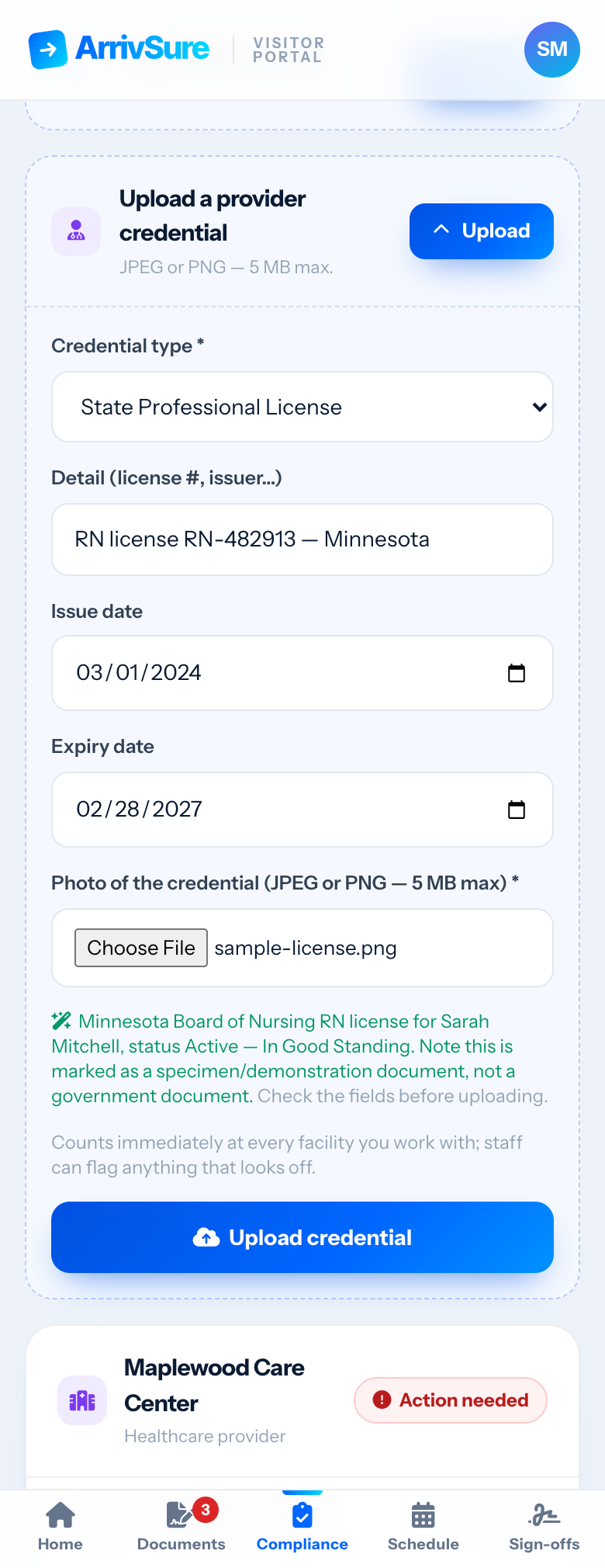 AI suggests document fields for staff to review and confirm.
Drafting communication under pressure. When staff need to notify hundreds of families about a weather closure or a policy change, a blank text box at a stressful moment produces bad messages. AI-drafted alerts give staff a clear, calm starting point they edit and approve — the human stays in charge, minus the blank page.
Synthesizing feedback nobody has time to read. Communities collect survey responses constantly and read them rarely. AI synthesis surfaces the patterns — and flags the urgent response that needs a callback today — instead of letting it age in a spreadsheet.
Briefing the people who run the building. Rolling up check-in trends, staffing coverage, and open issues into a plain-English morning briefing turns dashboard data into something an administrator actually reads before the stand-up meeting.
Where it's still hype
Honesty builds trust, so: be skeptical of AI that claims to predict which visitor will be a problem, replace front-desk staff outright, or make care decisions. The first is bias with a dashboard, the second underestimates what your receptionist actually does, and the third belongs to clinicians. AI at the front desk should remove typing, waiting, and blank pages — not judgment.
The family side: transparency as a feature
The same infrastructure that streamlines check-in can also support a clearer family experience. ArrivSure's available-now Visitor Portal can give invited visitors a phone-friendly place to complete configured questionnaires, documents, credentials, event tasks, and follow-up outside the lobby. Which steps are available depends on the facility's configuration and invitation.
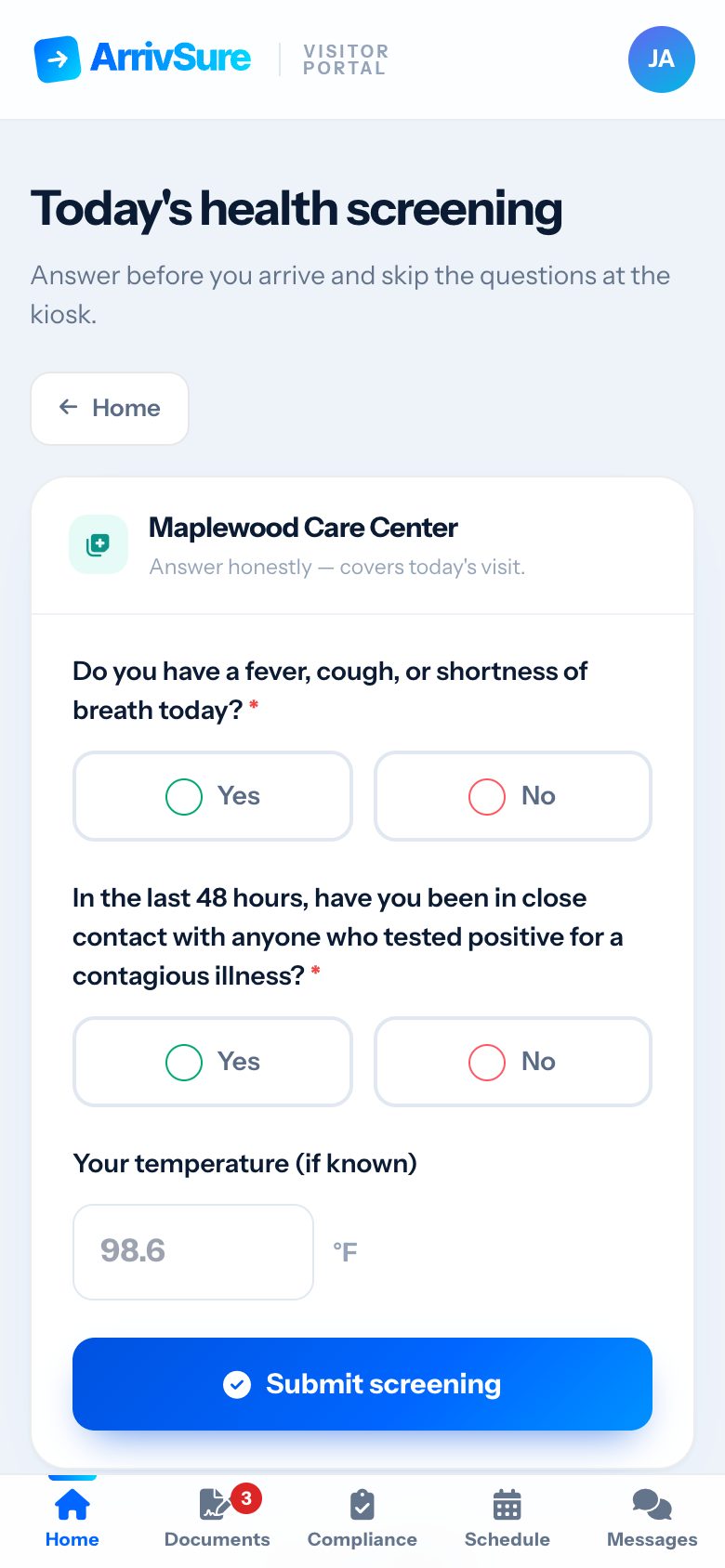 A current Visitor Portal example; the organization controls which steps it asks visitors to complete.
ArrivSure is also exploring a native visitor-app concept, but it is not currently available and its final scope or timing may change. That distinction matters: operators should evaluate what a vendor can deploy now separately from a roadmap. On the staff side, the available front-desk dashboard provides a current view of people recorded as on-site without making each arrival wait for a manual lookup.
Guardrails that make AI adoptable
If you evaluate AI-enabled systems this year, three guardrails separate serious vendors from demos:
- Data boundaries. When an AI vendor creates, receives, maintains, or transmits PHI for a HIPAA-covered entity, the parties generally need a business associate agreement and the applicable Privacy and Security Rule safeguards. Keep PHI out of tools that are not approved for that use.
- Cost controls. AI usage should have budgets and automatic cutoffs. "Surprise invoice" is not a feature.
- Human override everywhere. Every AI draft is editable, every AI flag is reviewable, every automated flow has a manual path.
These aren't nice-to-haves; they're what makes the technology deployable in a regulated building.
An adoption path from paper
A staged rollout can start by digitizing the arrival workflow, then adding approved family-facing tools, and finally layering AI onto governed data and defined staff-review steps. Measure adoption, time, errors, and experience at each stage before expanding.
The clipboard held on for decades because it was familiar. Today, operators have more options—and a responsibility to evaluate them against real workflow, privacy, accessibility, and staff needs.
Sources and current guidance
Last reviewed September 2, 2026.
- Argentum 2025 Technology Report
- LeadingAge/CAST technology leadership survey
- HHS guidance on business associates
- HHS guidance on cloud computing and ePHI
Confirm current privacy, security, and regulatory requirements with qualified advisors before putting sensitive information into an AI-enabled workflow.
Curious what an AI-assisted front desk looks like in a real community? Request a demo—bring your hardest check-in scenario.