In this article
Healthcare and social-assistance employers recorded the highest workplace-violence injury count and rate of any private-industry sector in BLS's 2021–2022 data: 14.2 cases per 10,000 full-time workers, compared with 2.9 across private industry.
The rules have not loosened. On January 1, 2026, The Joint Commission moved its hospital and critical-access-hospital workplace-violence requirements into a single National Performance Goal, NPG #2a. It added no new requirements, but it put workplace violence in the same chapter as medication safety and infection control. OSHA has no specific federal workplace-violence standard, though it can cite recognized hazards under the General Duty Clause.
Most programs built to meet these expectations have something in common: they are thorough about patients and staff, and nearly silent about the people who walk in off the street. Your violence-prevention program has a front-desk layer whether you designed one or not.
The lobby belongs in your risk assessment
Every program starts with a worksite assessment of where violence risk concentrates. Emergency departments top every hospital's list. In long-term care, the honest answer includes the front entrance:
- Domestic disputes follow people to facilities. An estranged spouse, a family member barred by a protective order, a custody conflict over who may visit a resident: these arrive through the lobby.
- Removed staff and contractors come back. A terminated employee still knows the building, the schedule, and the door codes.
- Family conflict escalates on site. Disagreements over care decisions, finances, or end-of-life choices play out in your building because your building is where the resident is.
If your risk assessment covers all of these and your control is "the receptionist will recognize them," you are relying on one person who isn't there at shift change, during agency coverage, or at the second entrance.
Screening lists done right
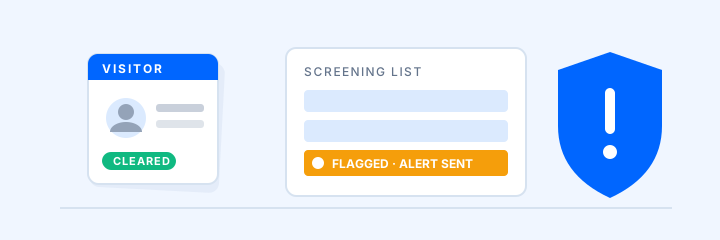
A screening list at check-in turns a policy into a control. People with documented restrictions (a protective order, a trespass notice, a removal for cause) are on the list, and the front desk no longer has to remember them.
Done right, it is careful, not theatrical:
- Specific and documented. Every entry carries an approved reason and its source, such as a court order or incident report, and follows your access and retention policies.
- Matched on more than a name. ArrivSure checks each arrival against the list by phone number, email, badge, and, when license capture is on, driver's-license number or legal name plus date of birth. Loose name matches don't page anyone.
- Stopped at the kiosk, with staff alerted at once. A banned visitor's check-in doesn't go through, and designated staff (security, the administrator, the charge nurse) get an alert with the person's name and the reason for the flag.
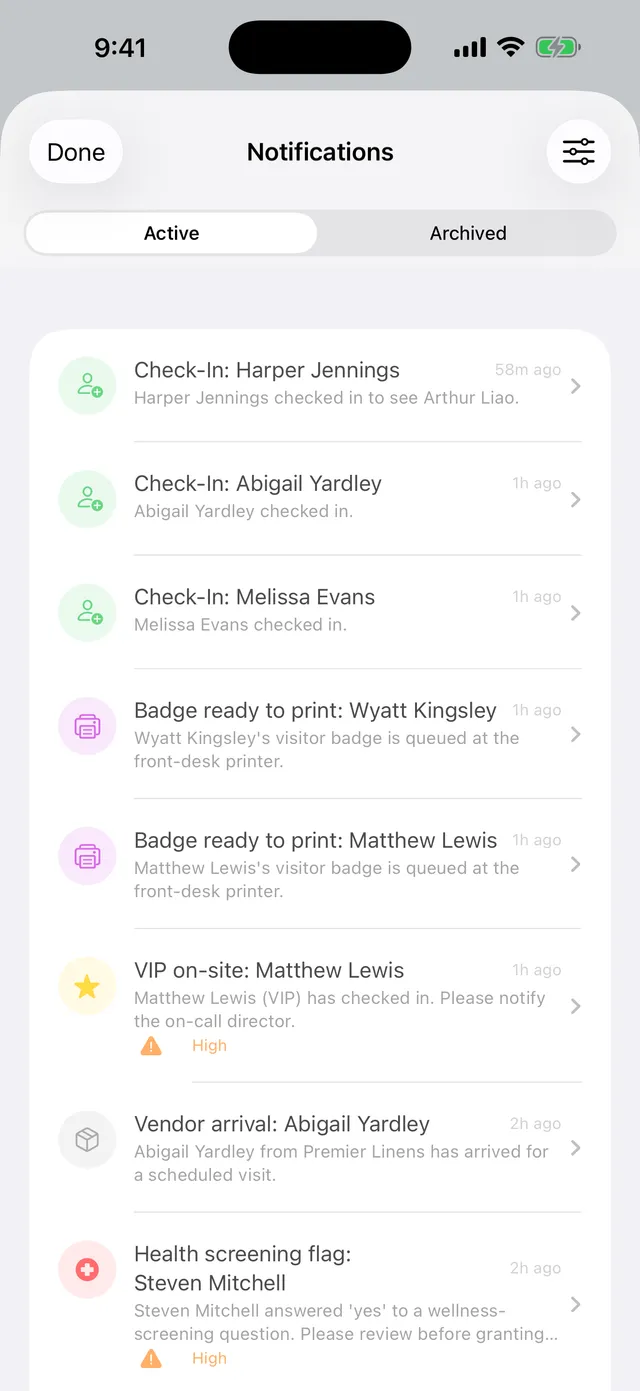
The alert gives staff time to act before the person reaches a resident's hallway. What happens next is your policy: who responds, who calls the police, and who stays with the resident.
Incident response needs a communication layer
A prevention program also needs a response process. When something happens, the first need is reaching everyone fast: lockdown, shelter in place, avoid the west wing, all clear.
Mass staff alerts go to the groups you define, by email and text, from the web dashboard or from a phone through the Companion app. Load the templates now, so nobody writes a lockdown message under pressure.
The records that hold up in a survey
Each step leaves a record: the screening-list entry and its documented basis, the time the alert went out and who received it, and the roster of everyone checked in at that moment. Surveyors and investigators ask for exactly that, alongside your policies, training records, and incident reports.
The software is one layer. Training, the worksite assessment, incident reporting, and follow-up with the staff involved still belong to your program.
Start with a one-hour audit
Sources and current guidance
Last reviewed September 28, 2026.
- BLS workplace-violence factsheet for 2021–2022
- The Joint Commission National Performance Goal #2a
- OSHA workplace-violence enforcement guidance
Requirements differ by setting and accreditor. Confirm yours with your regulator, accreditor, and safety advisors.
Want to see check-in alerts and screening lists on your own front door? Request a demo.
Request a 20-Minute Demo