
For twenty-five years, measles was a solved problem in the United States. In 2026, it isn't. More than 2,400 cases have been confirmed this year across dozens of jurisdictions — already the worst year since measles was declared eliminated in 2000, and the most cases the U.S. has recorded in 35 years — with over 90% tied to outbreaks. In November 2025, the Americas formally lost their regional measles elimination status after endemic transmission re-established itself in Canada, and the United States' own elimination status is now under formal review.
For long-term care operators, this isn't abstract public-health news. Your building concentrates exactly the people severe measles hurts most — immunocompromised residents and those on immune-suppressing treatments — and it welcomes hundreds of visitors and staff a week through the front door, any of whom can carry the virus in.
What CDC guidance actually asks of you
CDC's interim infection prevention recommendations for measles in healthcare settings include a line that lands squarely on the front desk: facilities should consider screening visitors for signs and symptoms before entry when measles is circulating in the community.
That word "community" is doing real work. You don't wait for a case inside your building — the trigger is transmission in your county or region. With nearly 40 outbreaks reported nationally this year, "is measles circulating near us?" is now a question every facility should be able to answer weekly, and the screening response should be something you can switch on in an afternoon, not a policy project.
Why the paper sign-in sheet fails an outbreak
Facilities that lived through 2020 already know this, but it bears repeating for the newest airborne threat, because measles is more contagious than COVID ever was — the virus hangs in the air for up to two hours after an infectious person leaves a room.
When a health department calls about an exposure, you need to answer three questions fast:
- Who was in the building during the exposure window?
- Where did they go, and who did they visit?
- How do we reach them — today, not after deciphering handwriting?
A clipboard answers none of these reliably. Illegible names, skipped lines, missing phone numbers, no checkout times. A digital visitor log answers all three in minutes: filter the log by date and time, see every visitor with a recorded phone number, and export the list for the health department.
Screen before the lobby, not in it
The pandemic-era instinct is a staff member at a table asking symptom questions. It works, but it burns labor and creates the confrontation nobody wants — turning a family member away face-to-face.
The better 2026 pattern is pre-visit screening: the questionnaire goes to the visitor's phone before they leave home. That's how ArrivSure's visitor portal handles it —
- Families complete the health screening remotely; only a passed screening skips the questions at the kiosk
- Anyone who reports symptoms gets guidance before driving over, with staff notified — no lobby standoff
- Screening questions are configurable, so you can add measles-specific items (rash, fever, exposure, MMR status) the day your county reports a case, and remove them when the risk passes
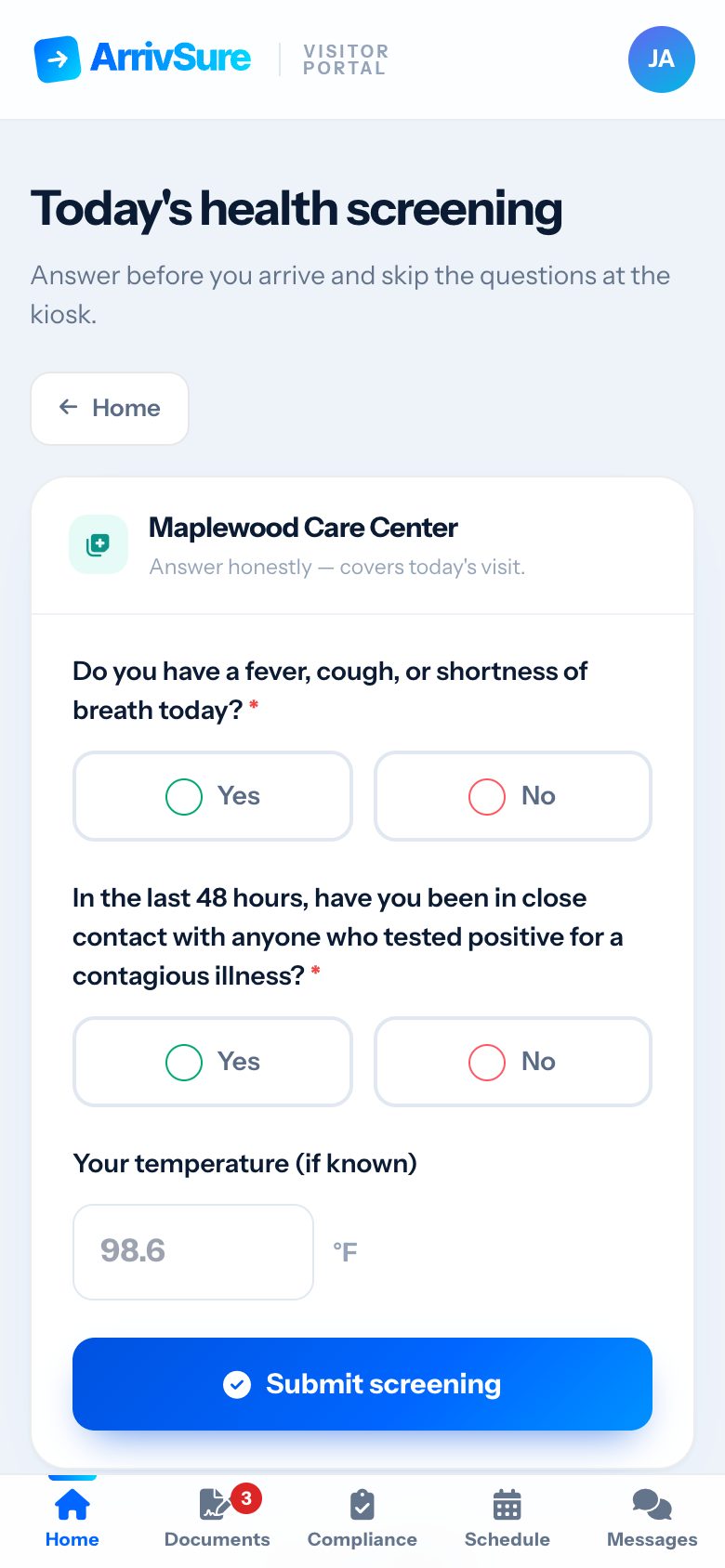 The screening happens on the couch, not in the lobby — and only a passed screen fast-tracks check-in.
For everyone else, the kiosk asks the same questions at check-in, so there's no gap in coverage — just a fast lane for the people who screened ahead.
Contact tracing in minutes, not days
When the exposure call comes, the visit log becomes your response plan:
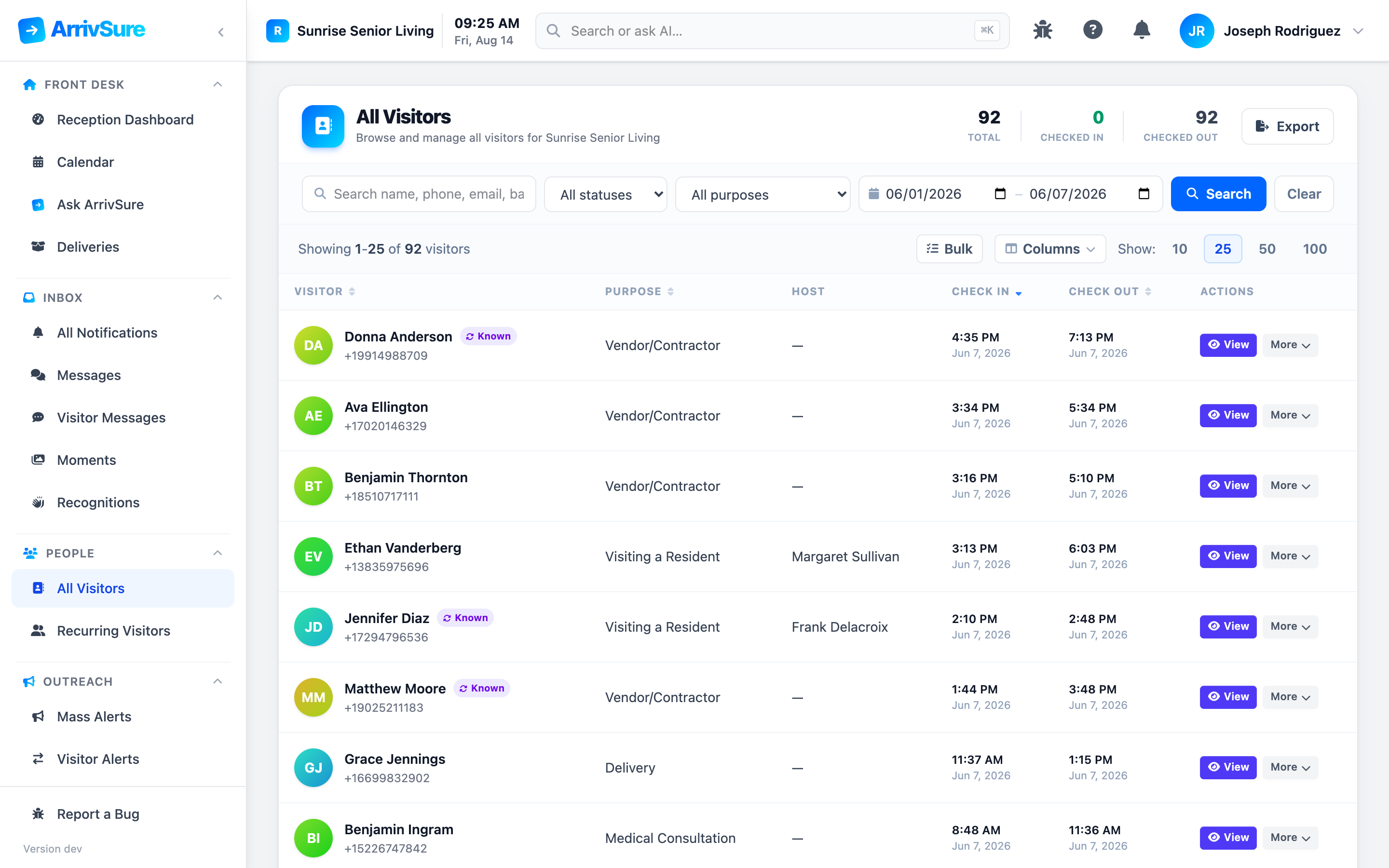 One filtered search produces the exposure list a health department asks for.
Every record carries a recorded contact method, arrival and departure timestamps, and who the visitor came to see — which means you can also proactively notify affected families through the same system, rather than posting a sign on the door and hoping.
A screening policy you can adapt today
A workable 2026 visitor-screening policy fits on one page:
- Trigger: activate enhanced screening when your health department reports local measles (or other airborne) transmission
- Method: pre-visit questionnaire via the portal; same questions at the kiosk for walk-ins
- Failed screens: automatic staff notification; offer a virtual visit or reschedule
- Records: retain screening results and visit logs for your health department's lookback window
- Deactivation: stand down enhanced questions when local transmission ends — screening fatigue is real, and credibility matters for the next event
Measles won't be the last airborne disease to test your front door. The facilities that handle 2026 gracefully are the ones treating visitor screening as infrastructure — always installed, switched on when needed — rather than a scramble.
Want screening you can activate in an afternoon? Book a demo and see pre-visit health screening on your own workflow.