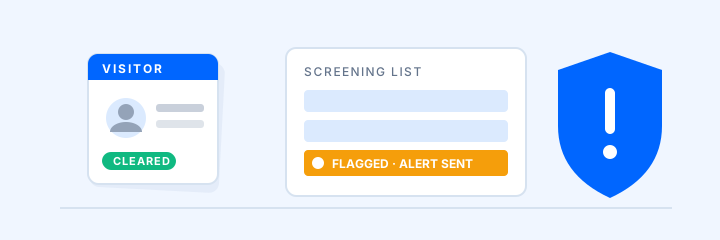
Healthcare workers experience workplace violence at rates far above nearly every other industry — and in 2026, the accountability for preventing it got sharper. The Joint Commission's National Performance Goals took effect January 1, elevating workplace violence prevention into a consolidated, measurable goal for hospitals, with defined expectations: a designated program leader, a multidisciplinary team, worksite risk assessments, incident reporting with follow-through, training at hire and annually, and post-incident response. OSHA's long-promised healthcare workplace-violence standard, meanwhile, remains stalled on the federal agenda — which leaves enforcement to the General Duty Clause, where healthcare employers keep getting cited without the compliance ceiling a defined standard would provide.
The new goals chapter formally applies to hospitals and critical access hospitals — and the underlying workplace-violence standards already extend across all of the Joint Commission's accreditation programs. Every long-term care and senior living operator should read them as the direction of travel for the entire industry. Surveyors, insurers, and plaintiff's attorneys all have a written standard for what "taking violence prevention seriously" looks like — one surveyors have been citing hospitals against since 2022, and that just became more prominent.
Here's what most programs built to meet these expectations have in common: they're thorough about patients and staff, and nearly silent about the population that walks in off the street. Your violence-prevention program has a front-desk layer, whether you've designed it or not.
The lobby is in your risk assessment — or should be
The framework starts with assessing where violence risk concentrates. Emergency departments top every hospital's list, but in long-term care the honest answer includes the front entrance:
- Domestic disputes follow people to facilities. An estranged spouse, a family member barred by a protective order, a custody conflict over who may visit a resident — these arrive through the lobby.
- Removed staff and contractors come back. A terminated employee still knows the building, the schedule, and the door codes.
- Family conflict escalates on site. Disagreements over care decisions, finances, or end-of-life choices play out in your building because your building is where the resident is.
If your risk assessment covers all of these and your mitigation is "the receptionist will recognize them," the assessment has identified a control that doesn't exist at shift change, with agency coverage, or at a second entrance.
Screening lists done right
The control that actually works is a screening list built into check-in: individuals with documented restrictions — protective orders, trespass notices, removal for cause — are flagged the moment they attempt to sign in, at any entrance, on any shift.
Done right, this is careful, not theatrical:
- Specific and documented. Entries carry a reason and a source (court order, incident report), not a vibe. That documentation is what protects you if the flag is ever challenged.
- Discreet at the kiosk. The kiosk can be configured to show the flagged person a neutral holding screen. Staff get the alert; the lobby doesn't get a scene.
- Instant and targeted. The right people — security, the administrator, the charge nurse — are notified on their phones in seconds, with the person's name, photo, and the reason for the flag.
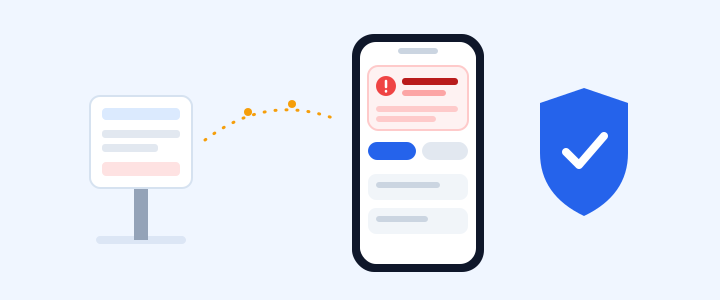 The alert reaches the right staff before the situation reaches the unit.
This is exactly how ArrivSure's check-in alerts work, and it converts your policy language — "restricted individuals will be identified upon entry" — into something that actually happens.
Incident response needs a communication layer
The 2026 expectations don't stop at prevention; they require defined response processes. When something does happen, the first operational need is reaching everyone fast — lockdown, shelter, avoid the west wing, all-clear.
That's what mass staff alerts are for: one action notifies every staff member across every channel, with delivery confirmation, so "we activated our response plan" is a log entry rather than a hallway rumor. The same system covers the follow-up the standards ask for — reaching, and supporting, the staff who reported or were affected — which is where most paper-based programs quietly fail.
The documentation that survives a survey
Every element above produces a record: the screening-list entry with its documented basis, the timestamped flag alert and who received it, the visitor log showing who was in the building, the mass alert and its delivery confirmations. Together they answer a surveyor's — or an attorney's — core question: you say you have a program; show me it operated.
A violence-prevention binder describes intentions. A check-in system generates evidence.
Start with a one-hour audit
Walk your own front entrance and ask: If a person under a protective order arrived at 7 PM on a Saturday, what would actually happen? Who would know, how fast, and what's the record afterward? If the answer depends on one person's memory, the fix isn't more policy language — it's putting the screening where every visitor already is: the front door.
Want to see check-in alerts and screening lists on your own facility's workflow? Book a demo.